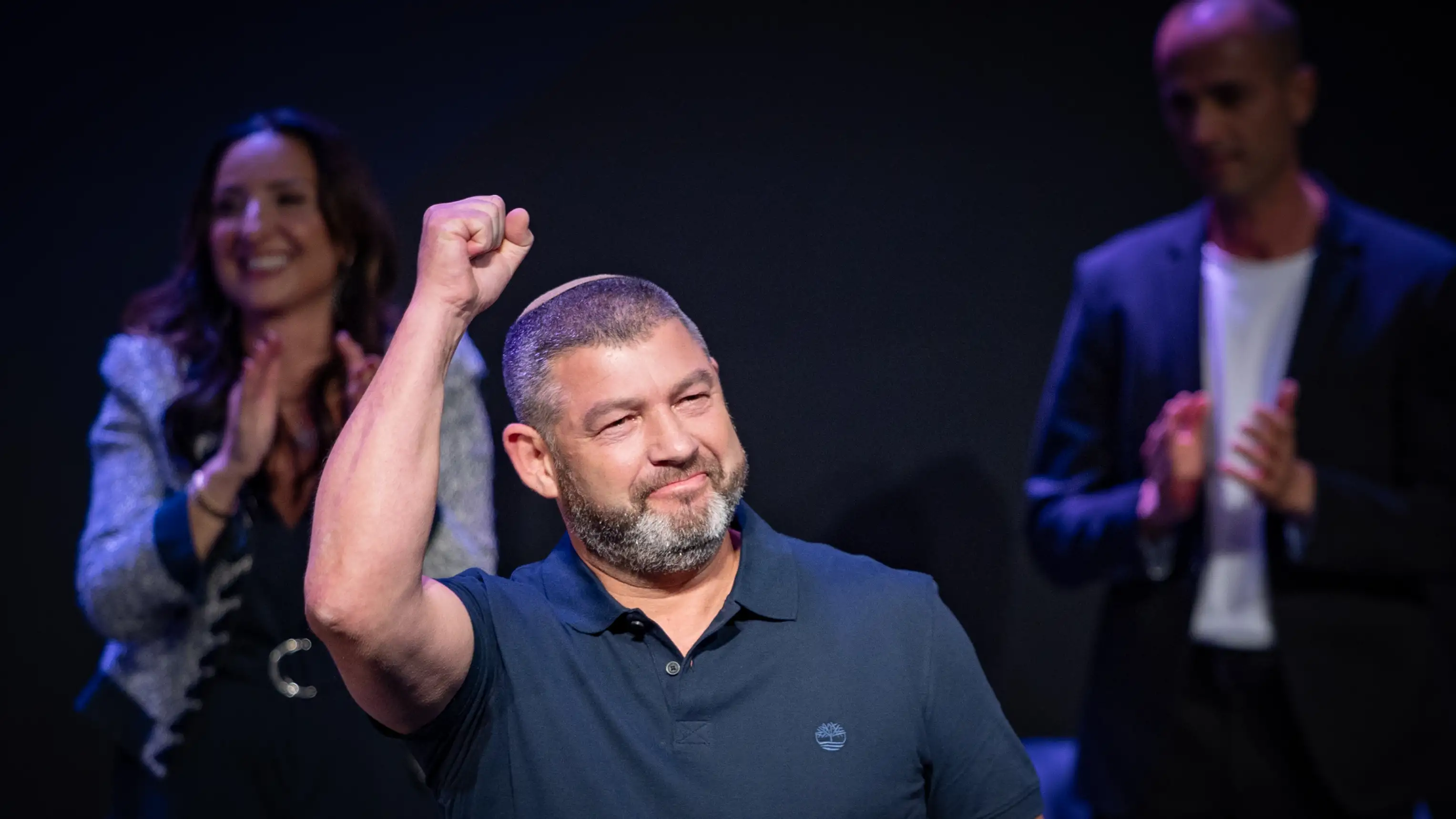
Brig. Gen. (res.) Ofer Winter is one of the officers in the IDF most identified with Religious Zionism. The eldest of four brothers, he grew up in Kiryat Ata. He attributes his legacy of combat to his father David, who fought 19 consecutive days on both sides of the canal in the Yom Kippur War.
Winter studied at the Or Etzion military boarding school and at the famous Bnei David pre-military academy in the settlement of Eli (in cohort B — one cohort after Naftali Bennett).
He enlisted in 1990 in the General Staff Reconnaissance Unit (Sayeret Matkal), moved to Maglan as a team commander, and from there to command positions in the Paratroopers and Givati Brigades. He commanded the Givati reconnaissance company and the Givati reconnaissance battalion during the Second Intifada in Gaza; the unit was awarded a unit citation and the Medal of Distinguished Service for a series of deep operations inside the Strip. Among them was Operation “Steel Cavalry,” in which 6 IDF soldiers were killed when an IDF armored personnel carrier was blown up in the Zeitoun neighborhood of Gaza.
The operation later became widely known because of Ofer’s decision not to leave Gaza until all the fighters were brought back. During the operation, Givati soldiers combed the area until they found the body parts of their comrades.
Later in his career, Ofer served as:
- Commander of the Duvdevan Unit — (during his tenure the unit won the Chief of Staff’s Prize)
- IDF liaison officer to the U.S. Marine Corps
- Commander of the Northern Brigade in Gaza and commander of the Givati Brigade during Operation Protective Edge
- Head of the Central Command staff; Military Secretary to Defense Ministers Avigdor Lieberman, Naftali Bennett, Benny Gantz, and Benjamin Netanyahu
- Commander of Fire Division 98, the IDF’s senior paratrooper and commando division
In 2016, then-Chief of Staff Gadi Eisenkot decided not to promote him to Major General, a decision that sparked public controversy and claims of a “glass ceiling for religious officers” in the General Staff. He was finally discharged in 2024.
He is married to Revital, father of 9 children, and lives in a religious community settlement in the Galilee.
Ahead of the 2026 elections, Winter founded the “Amecha Yisrael” (“Your People Israel”) party. His message rests on 3 pillars:
1. “In no arena have we achieved decisive victory”
This is the sentence that recurs in every interview. Winter argues that Israel is still “deep, deep inside the conception” even after October 7th. He demands a shift from containment to swift decisive victory.
2. Security with identity
“The righteousness of the path — this is our home, and therefore no state other than the State of Israel, which is the state of the Jewish people, will ever be established here,” he says. Additional principles: only Israel is responsible for its own security, not “foreign legions or technocrat governments in Gaza”; Ofer calls for promoting a policy of voluntary emigration from Gaza and applying full Israeli governance over all parts of the land.
3. A broad right-wing government not dependent on Goldknopf
Winter wants a broad right-wing government that combines religious, secular, and working Haredi Israelis, with an emphasis on drafting Haredim and integrating them into employment. He refuses to run on the Likud list despite being offered a reserved spot at #3 with a promise of the defense portfolio — on the grounds that he does not work for anyone and is not interested merely in landing a job in order to serve others’ foreign agendas.
Winter is explicitly aiming for the defense portfolio, and argues that the military leadership during Eisenkot’s term maneuvered the political echelon in order to avoid taking action in Gaza.
During the campaign, Winter became the target of relentless attacks from Benjamin Netanyahu, who has repeatedly claimed that Winter is not loyal to the right-wing camp and that he will not clear the electoral threshold. In practice, even according to the most conservative polls, Ofer enjoys broad support from hundreds of thousands of Israelis who are drawn to the new, refreshing spirit he brings.
In response to Netanyahu’s attacks, many on the right are asking: if Netanyahu is so interested in forming a right-wing government, why doesn’t he encourage a few thousand people to support Ofer and ensure he clears the electoral threshold with certainty? What is the real reason Ofer is hated and pursued by Netanyahu — especially after he proved his loyalty to Netanyahu and announced right at the start of the campaign that he would support only him for prime minister?
On the War
Brig. Gen. (res.) Ofer Winter’s security doctrine on the Iron Swords War
Since his discharge from the army, Winter has presented a consistent hawkish line focused on criticism of the absence of a swift military decision, the prolongation and dragging out of the war, and an enormous waste of resources on the Israeli side (including, of course, many casualties among the fighting forces). All these failings, he says, stem from a deep conceptual failure tied to a confusion of values and morality that has taken hold among Israel’s senior decision-makers.
Winter argues forcefully that Israel has not achieved a clear decisive victory in any arena. In his view, the State of Israel and its defense establishment are still deep inside the old “conception,” which prevents them from winning.
In one of his speeches he described Hamas’s army as the weakest Arab army in the Middle East — “a few ragtag Palestinians” — and described Hezbollah as an enemy that could have been defeated far more easily had Israel only “taken off the gloves” and acted swiftly and decisively, exploiting the stunning momentum achieved in the pagers operation and the elimination strikes against Hezbollah’s senior leadership, headed by Nasrallah.
Another major part of Ofer’s criticism is directed at the way Israel has handled the humanitarian and legal dimensions of the war:
In his view, one of the central mistakes of the war is the provision of broad humanitarian supplies to the entire Gaza Strip (and of course directly to Hamas itself as well), with no distinction whatsoever — a distinction that must be made — between uninvolved civilians and fighters of the murderous terrorist organization.
Winter contends that providing humanitarian aid to the enemy itself, alongside strict self-imposed legal restrictions that the IDF places on itself, prevent Israel from exercising its true strength and preserve Hamas’s control and its military frameworks.
He argues that this conduct, combined with prolonged negotiations, numerous ceasefires, and capitulation to the extortion and conditions of the terrorist organizations, granted Hamas leader Yahya Sinwar a global status in the eyes of the Arab world as a kind of “modern-day Saladin.”
This is mainly because he did to Israel what no Arab leader before him had managed to do — and that despite Israel’s overt power, it did not bring the organization to seek a ceasefire, let alone face total destruction; on the contrary, it brought Israel to sign the 21-clause agreement, which grants Hamas a charter in Gaza, preserves its rule, and even obligates Israel to recognize a path toward a Palestinian state...
Despite the scathing criticism, Winter is careful to separate the fighting forces at the maneuvering and operational level from the decision-makers. In his words, the commanders and fighters on the ground want to win and are capable of winning, and the problem does not lie with them. Instead, he accuses the political and military leadership of being overly preoccupied with internal feuds and political survival, instead of investing all their energy in eliminating Hamas and winning the war. He has even pointed an accusing historical finger at former senior IDF officials (such as Gadi Eisenkot), claiming they instilled concepts in the army that prevented timely strikes and decisive action.
Ofer’s proposals for the immediate repair of Israel’s national security include:
- A complete reform of the defense establishment.
- A comprehensive reform of force-buildup processes, across all branches and organizations.
- Creative, decisive, and cost-efficient employment of the ground forces.
- Promotion of excellent military thinking.
Three Years into Iron Swords — Brig. Gen. Ofer Winter
Simchat Torah, October 7, 2023 — was a day of darkness and great concealment. It was very hard for me; I knew the Gaza sector well, having had the privilege of commanding, as a brigade commander, the northern sector of Gaza for over a decade.
Since then, for three years now, we have been in a long and difficult war over our very existence. The people of Israel, at home and throughout the world, are going through difficult days. But within the great darkness (and certainly the further we get from it) I manage to see wondrous points of light that, for me, constitute hope and comfort. I want to tell you about these points of light.
The first point of light is the spirit of the people of Israel. The victory generation.
The further we got from the event, the more I understood that I was seeing a giant pillar of light — a new-old spirit had begun to beat within the nation. A spirit of self-sacrifice, a spirit of devotion and volunteering. A spirit of unity and mutual responsibility. A positive spirit — “Here I am,” “What can I contribute, how can I help.” Soldiers, police officers, and civilians who leapt with total self-sacrifice into the fire. Units that ran forward into the chaos — the heroes of our people. Young women, mothers who sacrifice everything, bereaved families, reservists who stopped counting days. We cannot describe here the heroism of our people, nor can we capture its spirit in words.
This spirit of the victory generation is going to replace the leadership of anti-ism, the leadership of division, the leadership that placed the self at the center — the one that has led us in recent decades.
I can identify a new tier of leadership growing here before our eyes.
In fairness, we must stop and say here that many attempts have been made, and continue to be made, in recent years to divert the focus from the central issue and from the essence of the problem we face:
For example, the inquiries so far have focused on the fighting echelon — the one that was on the ground fighting for its life and for the lives of the residents, without any real chance.
They have dealt with placing full responsibility on the intelligence bodies that failed, such as Military Intelligence (Aman) and the Shin Bet.
And a real attempt has been made to narrow the view so as to deal only with the question “How were we surprised on October 7, and why did we fail to carry out the mission of defending the residents of the Gaza-border communities.” This is indeed an important topic, but it is designed to divert the discussion away from the essence and from those truly responsible, and to buy time.
As a rule, the fighting echelon — from brigade level down — is not to blame for this surprise attack that was forced upon it. It had no chance of stopping it. Therefore, to blame the fighting echelon, as if it were not good enough, is exactly like the accusations made against this echelon in 1973 by the decision-makers — who even dared to accuse the unfortunate soldiers of the Bar-Lev Line strongholds of the very fact that they “dared” to fall into captivity!
It is clear that this is a terrible and dreadful injustice, because the fighters and commanders on the ground — those who survived the inferno and remained alive — already feel terrible about themselves (as if they supposedly did not accomplish the mission). So instead of the senior officials standing up and saying, “We are to blame, we failed you, you were a hundred percent”... they keep investigating them and focusing on them... there is no limit to the shame.
The question of where the warning from Military Intelligence and the Shin Bet was is also the wrong question. It is clear there was a failure and there were failings around October 7, but it is equally clear that if it hadn’t happened on that day, it would have happened at another time — and perhaps on another front as well. The important question that almost no one asks (deliberately) is: how did we let these monsters (Hamas and Hezbollah) grow so wild, right on our border, at such a short distance from our wives and children — and on top of that, we fed them and nurtured them for 25 years! That is the question!
And to this question there are two answers: arrogance and naivety.
Israelis fall into the trap whenever someone says “peace” to us. We need to understand that in the Middle East, the word “peace” is not respected — peace is for the weak in the Middle East. In Islam, this word does not exist; in its place there is “hudna.” And the meaning of a hudna is different: to postpone the war until I am stronger and have another opportunity to destroy my enemy.
Therefore, we must not be foolish and naive. We must confront reality. And precisely the one who hates war and loves peace must be a lion.
Only a lion can make peace in the jungle. “The wolf shall dwell with the lamb” — but I am not willing to be the lamb. Until peace arrives, we must be the wolf, or better, the lion — with a good heart that wants peace... but a lion.
Hamas and Hezbollah have told us the whole time: we want to kill you. Sinwar said more than once, “I will slaughter you,” but we think we know better than him, and we tell him: no, you don’t. You actually want peace. You want Qatari money, an arrangement — we’ll just improve your socioeconomic situation, or give you a state in our own backyard, and then you’ll turn into Singapore. And there will be peace.
Our war continues, now also on the political front.
We act out of complete faith that our war is just and moral, and that the war we are fighting today is a war for the right to live as Israelis in the land of our forefathers, and also as free Jews throughout the world.
And contrary to the political rumblings around us, this is not a war over control, ego, or honor.
We are the sons of Abraham, Isaac, and Jacob, and of those who left Egypt and walked the desert for 40 years. We are the sons of those who lived in the Land of Israel and were exiled into the Assyrian and Babylonian captivities and during the era of the Roman Empire. We returned home after 2,000 years, and we are fighting, in our own land, the most just war there is.
We do not apologize. We have returned home. We have a great destiny before us: to bring peace and justice to the entire world, to bring blessing to the entire world. Together, and only together, we will win.